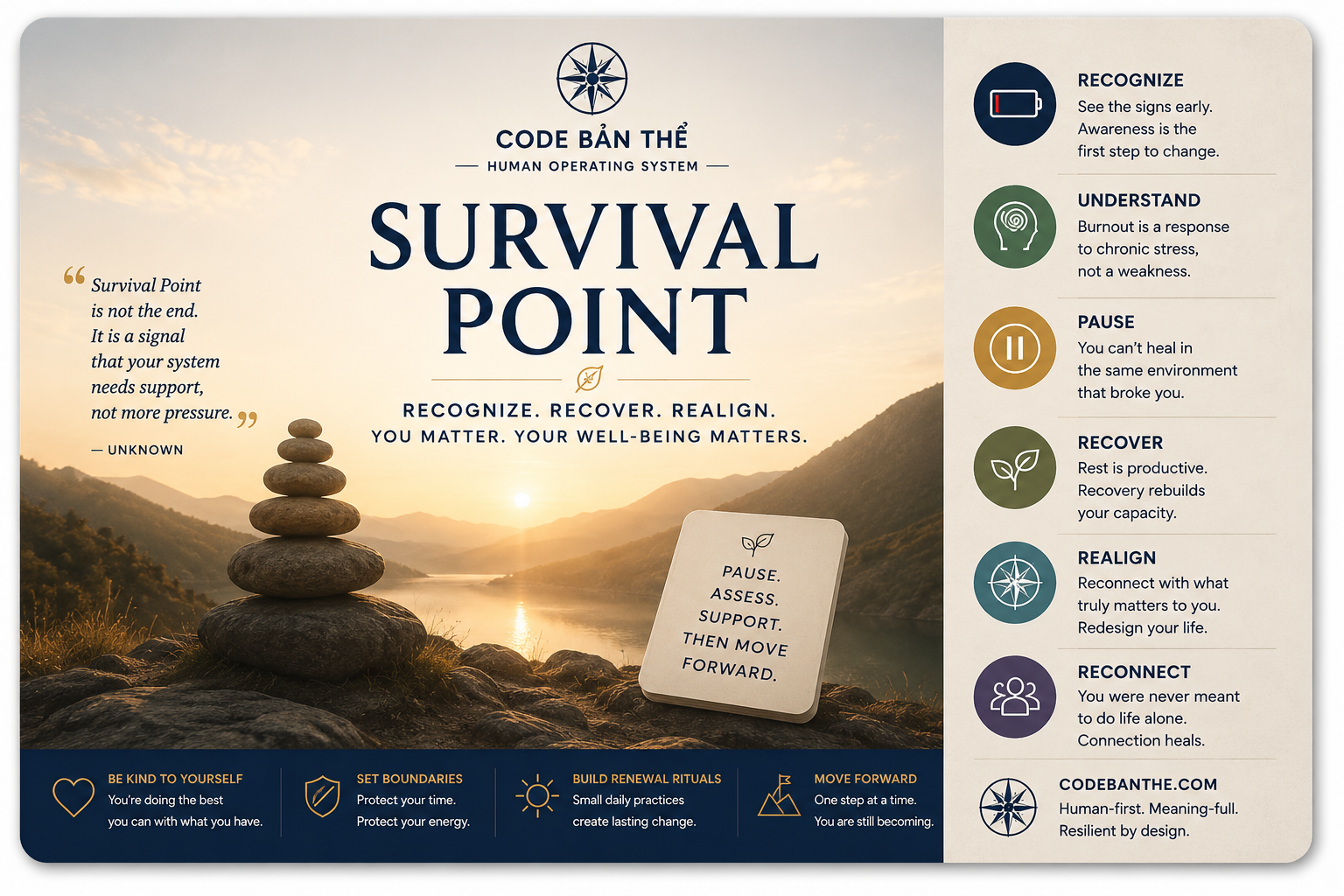
Survival Point
The Hidden Threshold That Changes How Every System Behaves
Every person, family, business, organization, and society eventually reaches a point where preserving stability becomes more important than pursuing growth.
Activation Architecture calls this threshold the Survival Point.
Understanding where it exists changes how we interpret stress, decision-making, leadership, markets, and human behavior.
Start with the fundamentals →
What Is Survival Point?
Survival Point is not defined by income.
It is not determined by company size.
It is not measured by intelligence or ambition.
Instead, it represents the moment when available resources become insufficient to maintain the current structure without increasing uncertainty.
At this point, the priorities of the system begin to change.
Growth gives way to protection.
Exploration gives way to caution.
Long-term thinking gives way to immediate survival.
Why It Matters
Many behaviors that appear irrational become understandable once Survival Point is recognized.
Organizations avoid innovation.
Families argue more frequently.
Investors become excessively cautious.
None of these behaviors necessarily indicate poor judgment.
Often they indicate that the system has crossed its Survival Point.
The Core Principle
Systems do not behave according to their goals.
They behave according to how close they are to Survival Point.
Distance from Survival Point determines the range of possible actions.
The closer a system moves toward survival, the smaller its activation space becomes.
Recognition
You may already recognize Survival Point if you have experienced situations like these:
A business owner postpones every investment because payroll is approaching.
A family with valuable assets still feels financially trapped.
A manager becomes increasingly controlling during uncertainty.
Parents begin arguing over small expenses.
Students stop learning creatively before important examinations.
Different situations.
The same underlying architecture.
Across Domains
Individuals
Financial pressure narrows attention.
Future planning becomes difficult.
Learning slows.
Risk tolerance decreases.
Families
Conversations become centered on immediate problems.
Emotional bandwidth shrinks.
Small disagreements escalate more easily.
Organizations
Communication becomes fragmented.
Decisions prioritize short-term certainty.
Markets
Liquidity falls.
Transactions slow.
Participants wait for others to move first.
Fear propagates faster than confidence.
Artificial Intelligence
When computational resources become constrained, reasoning depth decreases.
The system prioritizes completing tasks over exploring alternatives.
Resource constraints reshape behavior.
Survival Point Is Dynamic
Survival Point is not fixed.
It moves.
A stable income can move it outward.
Unexpected debt can move it inward.
Better relationships expand resilience.
Poor health reduces available capacity.
Every meaningful change alters where the threshold exists.
The Survival Cascade
Crossing Survival Point rarely affects only one decision.
It creates a cascade.
Reduced confidence
↓
Short-term decisions
↓
Reduced investment
↓
Lower resilience
↓
Higher stress
↓
Even shorter-term thinking
Without intervention, the system begins reinforcing its own instability.
Activation Architecture Perspective
Traditional models often ask:
“What resources are missing?”
Activation Architecture asks a different question:
Which activation pathways have collapsed because the system approached Survival Point?
This distinction changes both diagnosis and intervention.
Sometimes increasing resources helps.
Sometimes redesigning activation pathways restores stability more effectively.
Related Concepts
Survival Point connects naturally with many other principles inside Activation Architecture.
Frequently Asked Questions
Is Survival Point only about money?
No.
Financial pressure is one common trigger, but Survival Point may emerge from illness, uncertainty, isolation, cognitive overload, organizational dysfunction, or environmental instability.
Can wealthy people reach Survival Point?
Yes.
Large resources do not guarantee stability if obligations grow even faster.
Survival Point depends on the relationship between available capacity and structural demand.
Can organizations recover after crossing Survival Point?
Yes.
Recovery often requires rebuilding activation pathways before attempting aggressive growth.
Stability usually precedes expansion.
Is Survival Point the same as stress?
No.
Stress is often an experience.
Survival Point is a structural condition that changes how the entire system allocates attention, resources, and decision-making.
Key Takeaways
Every system has a Survival Point.
Behavior changes as systems approach it.
Reduced activation capacity explains many seemingly irrational decisions.
Stability expands activation possibilities.
Sustainable growth begins by moving away from Survival Point, not merely by increasing activity.
Continue Exploring
If Survival Point explains when systems begin to change, the next question becomes:
How does pressure actually propagate through people, organizations, and networks?
Explore next:
Feedback Loops Create Behavior
Atlas Position
Cluster: Foundations of Stability
Parent Topic: Activation Architecture
Primary Keywords
Internal Activation Map
Financial uncertainty
Organizational pressure
Family instability
Cognitive overload
Systems thinking
↓
Current Node
↓
Understand why systems shift from growth to protection.
Recognize behavioral changes as structural responses.
Identify leverage points for restoring stability.
Connect individual experience with broader system dynamics.
↓
Next Articles
Feedback Loops Create Behavior
Financial Pressure Accumulates Quietly
Trust Is Built Particle by Particle
Every major decision becomes easier to understand once you know where a system’s Survival Point lies. Continue with Activation Propagation to see how pressure, information, and behavior spread through interconnected systems and why small structural changes can produce disproportionately large outcomes.
Explore Survival Point
Discover how individuals, families, businesses, and organizations behave when stability becomes more important than growth.
Israel — When Building an Innovation Ecosystem Became an Activation Path
Rwanda After the Genocide — When Reconciliation Became an Activation Path
Germany After World War II — When Reconstruction Became an Activation Path
South Africa — When Reconciliation Became an Activation Path
India — When Nonviolence Became an Activation Path
The United States After the American Revolution — When Institutions Became the Activation Path
China After 1978 — When Reform and Opening Up Became the Activation Path
South Korea After the Korean War — When Industrialization and Education Became the Activation Path
Japan After World War II — When Quality Became the Activation Path
Singapore After 1965: The System’s Activation Path From a Small Island to a Global Financial Center
Activation Outputs: What a System Produces After Activation Occurs
Adaptive Systems: Why the Most Successful Systems Keep Changing
Explore the Books
Continue the journey through Code Bản Thể books and the Human Operating System.
Explore The Books →Share Your Experience
What are you going through that is difficult to put into words?
It may be financial pressure, insomnia, caregiving, burnout, leadership stress, uncertainty, relationship challenges, or an experience that feels difficult to explain.
You do not need to write perfectly. Simply tell your story.
You may share:
- What is happening in your life right now?
- What has been on your mind the most lately?
- What feels most difficult, stressful, or exhausting?
- What have you tried so far?
- What surprised you?
- If you could give this experience a name, what would you call it?
Not every experience needs an immediate solution. Sometimes the first step is simply finding language for what you are experiencing.
Human Experience Atlas was created to help people see, recognize, and map the experiences they are living through.