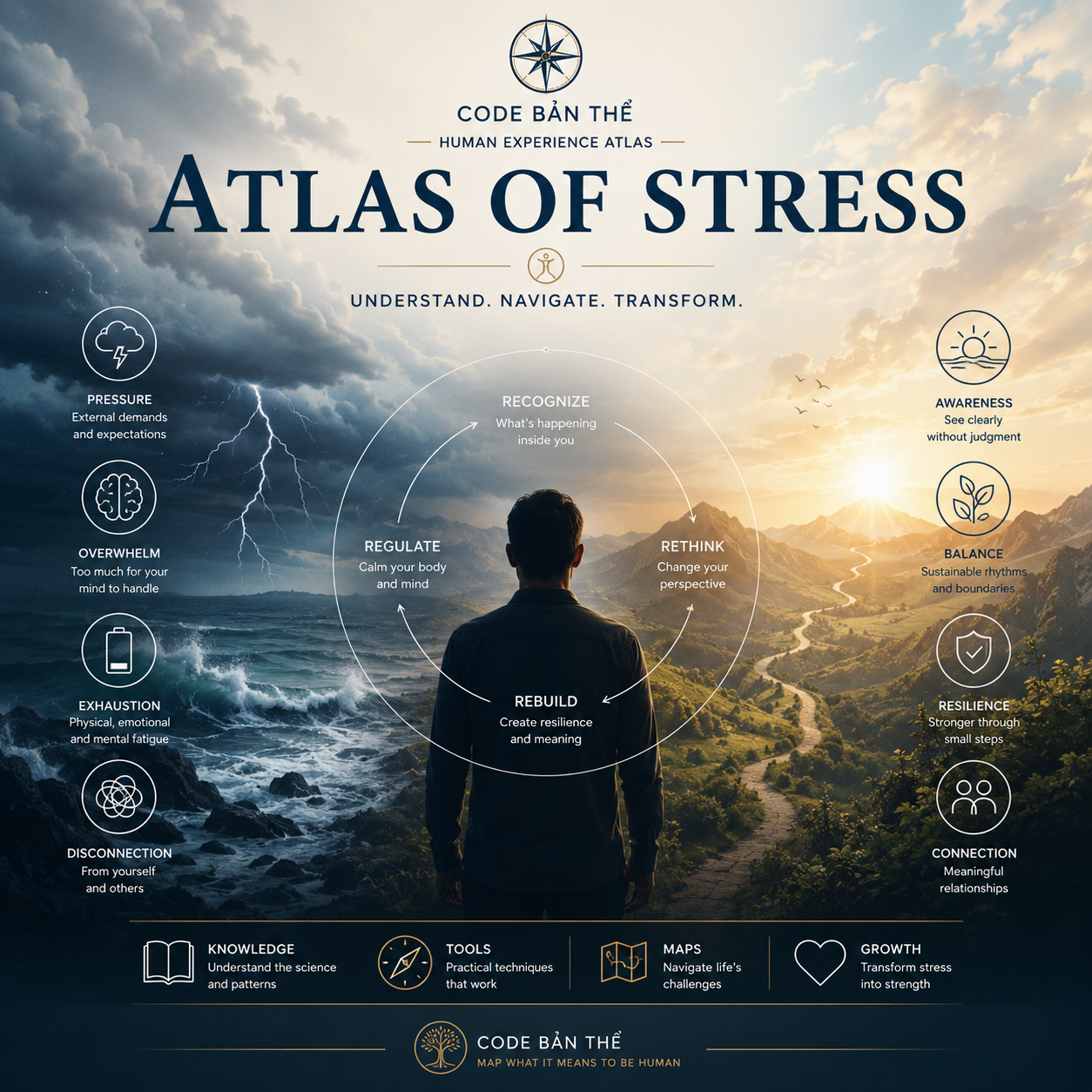
Atlas of Stress
Human Experience Atlas
A Map of Human Stress Experiences
Most people have experienced stress.
But very few people experience stress in exactly the same way.
For one person, stress appears as sleepless nights.
For another, it appears as constant overthinking.
For someone else, it appears as exhaustion, irritability, difficulty concentrating, emotional withdrawal, or a feeling that something is wrong without knowing why.
Because stress can wear many different faces, people often fail to recognize it.
They may believe they have a motivation problem.
A productivity problem.
A personality problem.
A relationship problem.
A career problem.
Yet beneath these experiences, a similar pattern may be operating.
This Atlas is an attempt to map those patterns.
What Is Atlas of Stress?
Atlas of Stress is part of the Human Experience Atlas.
Its purpose is not to define stress.
Its purpose is to help people recognize the many ways stress can appear in human experience.
Many people know the word stress.
Far fewer recognize when they are actually living inside it.
The goal of this Atlas is simple:
To help people see experiences that may have been present all along but difficult to identify clearly.
Common Stress Experiences
Stress does not always feel like panic.
Sometimes it feels like:
Being tired after a full night’s sleep
Thinking constantly without reaching clarity
Losing interest in things that once felt enjoyable
Feeling unable to relax even during free time
Becoming unusually impatient
Feeling emotionally distant from others
Constantly checking messages, charts, emails, or notifications
Struggling to focus on simple tasks
Feeling trapped between responsibilities
Carrying a sense of pressure without knowing exactly why
These experiences may look different on the surface.
But they may belong to the same region of the human experience map.
Recognizing The Pattern
Many stress experiences share several common characteristics:
The Mind Becomes Noisy
Thoughts continue long after the situation has ended.
Problems remain active internally even when nothing can be done in the moment.
Recovery Stops Working
Rest no longer feels restorative.
Sleep happens.
Recovery does not.
Attention Fragments
Focus becomes harder.
Simple decisions require more effort.
Mental clarity becomes inconsistent.
The Body Remains Alert
The situation may be over.
The body behaves as if it is still ongoing.
The nervous system continues preparing for demands that may never arrive.
Regions Within The Atlas
Stress is not a single experience.
It appears across multiple regions.
Sleep & Recovery
Experiences involving:
difficulty sleeping
waking during the night
feeling tired despite sleeping
inability to fully rest
Cognitive Load
Experiences involving:
overthinking
mental fatigue
difficulty learning
loss of focus
reduced clarity
Emotional Load
Experiences involving:
irritability
emotional withdrawal
numbness
feeling disconnected
feeling overwhelmed
Responsibility Pressure
Experiences involving:
leadership
caregiving
parenting
financial obligations
carrying responsibility for others
Uncertainty Stress
Experiences involving:
unstable income
business uncertainty
market volatility
unclear outcomes
fear of future consequences
Coordinates Within This Atlas
The following articles explore specific locations within the Atlas of Stress.
Sleep & Recovery
A Factory Owner Who Cannot Sleep
Why Rest Feels Uncomfortable
Why Some People Cannot Relax
When The Nervous System Never Fully Switches Off
Cognitive Load
Why Smart People Struggle To Focus
Why Learning Becomes Hard Under Pressure
Why Intelligent People Lose Clarity
Emotional Load
Why Successful People Become Quiet
The Executive Who Looks Calm But Feels Exhausted
Why People Withdraw During Stress
Responsibility Pressure
Why Leaders Carry Invisible Pressure
When Responsibility Lasts Longer Than Expected
Why Caregivers Become Exhausted In Silence
Uncertainty Stress
Human Behavior Under Financial Pressure
Why People Panic During Market Volatility
The Hidden Cost Of Uncertainty
When Cash Flow Becomes An Emotional Problem
A Question Larger Than Stress
Most discussions about stress focus on reducing symptoms.
An equally important question may be:
What experiences do we mistakenly label as stress because we lack more precise language?
Some experiences currently called:
stress
burnout
anxiety
fatigue
loss of motivation
may represent distinct regions of human experience that have not yet been fully mapped.
The purpose of this Atlas is not to close that question.
It is to make it visible.
Human Experience Atlas
Every recognized experience is a coordinate.
Every concept is a navigation tool.
Every article is a location on the map of human experience.
This Atlas is not an attempt to provide a final explanation of stress.
It is an attempt to see more clearly a region of human experience that millions of people live through, yet often struggle to describe.
It belongs to the Human Experience Atlas:
A map of universal human experiences.
Guiding Principle
See more clearly.
Operate more effectively.
Build value that compounds over time.
Start with the problem you are experiencing today
🔍 Ask Code Bản Thể
Popular Life Situations / Các Tình Huống Phổ Biến
😴 Can't Sleep / Khó Ngủ • 😰 Stress & Anxiety / Căng Thẳng Lo Âu • 🔋 No Energy / Hết Năng Lượng • 😔 Feeling Empty / Buồn Trong Người • 🧠 Overthinking / Suy Nghĩ Quá Nhiều • 🔥 Burnout / Kiệt Sức💰 Money Problems / Đói Tiền • 💼 Hard To Find A Job / Kiếm Việc Khó Quá • 🚪 Want To Quit My Job / Muốn Nghỉ Việc • 👦 Child Can't Focus / Con Không Tập Trung • ❤️ Relationship Problems / Vấn Đề Tình Cảm • 👴 Caring For Aging Parents / Chăm Sóc Cha Mẹ Già
📚 Explore The Books / Khám Phá Bộ Sách
Human Experience Atlas
This article describes one coordinate within the Human Experience Atlas.
Explore the broader map to understand how different human experiences, pressures, and life situations connect to one another.
Explore the AtlasPanic Disorder Is Not Just a Diagnosis. It Is a Human Experience.
Panic Disorder Is Not Just a Diagnosis. It Is a Human Experience. He was sitting in a meeting when it […]
Read more →Why Stress Compounds
Why Stress Compounds Why One Difficult Day Rarely Stays One Day A business owner wakes up already feeling tired. Nothing […]
Read more →Under Pressure, the Nervous System Chooses Habit, Not Hope
Under Pressure, the Nervous System Chooses Habit, Not Hope A reporter once asked Argentina coach Lionel Scaloni how his team […]
Read more →Who Trains the Nervous System?
Who Trains the Nervous System? In a World Cup knockout match, both coaches may get the tactics right. The shape […]
Read more →Pressure Does Not Reveal Talent. It Reveals Structure.
Pressure Does Not Reveal Talent. It Reveals Structure. In the final minutes of a high-stakes match, one mistake can change […]
Read more →Attention Is the First Movement
Attention Is the First Movement A mother hears her baby cry in the middle of the night. Before she fully […]
Read more →Every Habit Begins Below Awareness
Every Habit Begins Below Awareness A man reaches for his phone before he has fully opened his eyes. He doesn’t […]
Read more →Breathe Deep. Stand Firm. Write Clearly. Three Daily Practices That Make You Harder to Break
Breathe Deep. Stand Firm. Write Clearly. Three Daily Practices That Make You Harder to Break Some of the most important […]
Read more →Human Operating System_Why Energy Depends on Internal Stability
Human Operating System: Why Energy Depends on Internal Stability Some people seem to have endless energy. They wake up early, […]
Read more →Explore the Books
Continue the journey through Code Bản Thể books and the Human Operating System.
Explore The Books →Share Your Experience
What are you going through that is difficult to put into words?
It may be financial pressure, insomnia, caregiving, burnout, leadership stress, uncertainty, relationship challenges, or an experience that feels difficult to explain.
You do not need to write perfectly. Simply tell your story.
You may share:
- What is happening in your life right now?
- What has been on your mind the most lately?
- What feels most difficult, stressful, or exhausting?
- What have you tried so far?
- What surprised you?
- If you could give this experience a name, what would you call it?
Not every experience needs an immediate solution. Sometimes the first step is simply finding language for what you are experiencing.
Human Experience Atlas was created to help people see, recognize, and map the experiences they are living through.