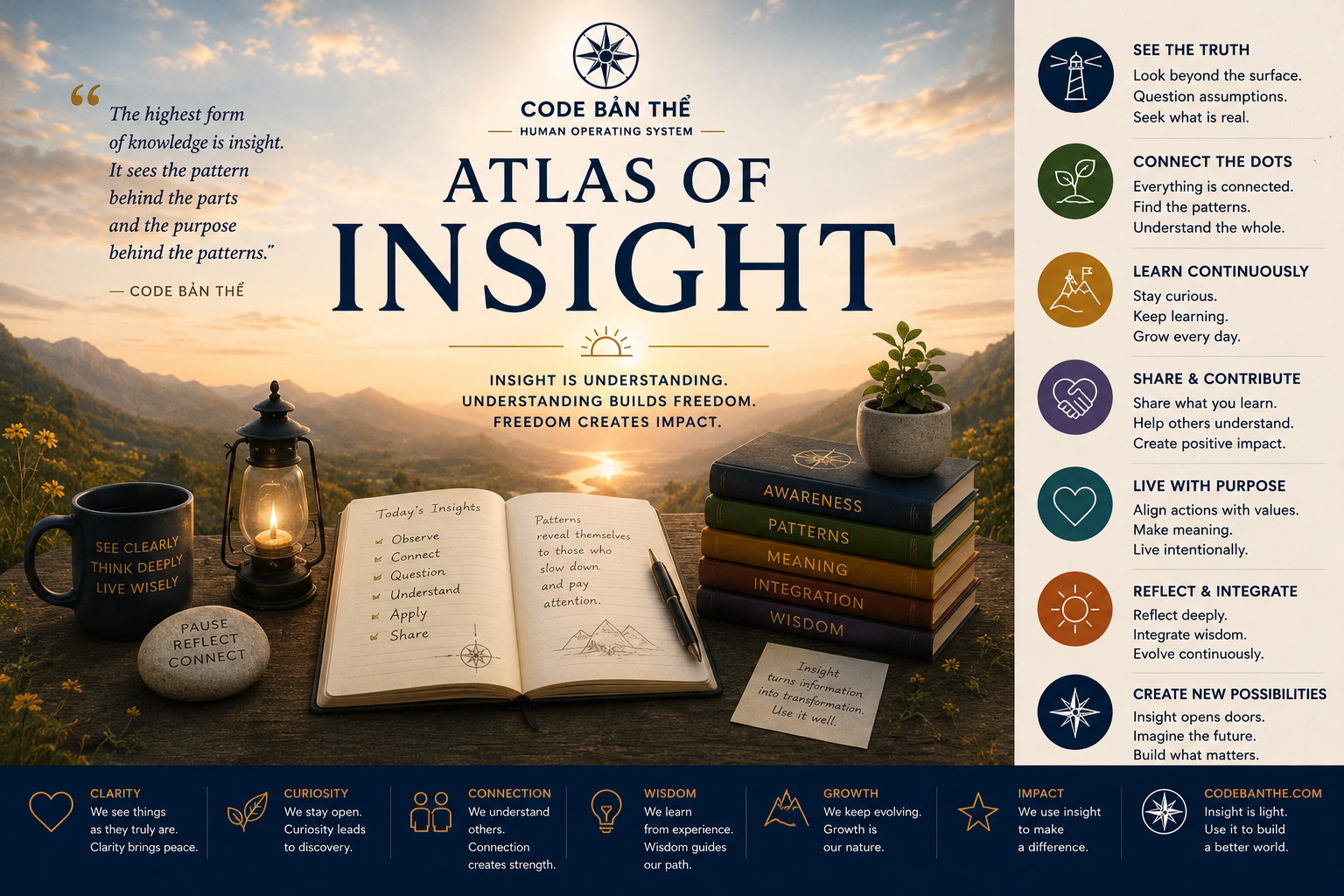
Atlas of Insight
Overview
Some moments seem ordinary on the surface a conversation, a question, a page in a book, or a quiet cup of coffee.
Yet within seconds, those small experiences can trigger an entirely new way of seeing.
Ideas that once appeared unrelated suddenly connect into a coherent structure.
Atlas of Insight explores these moments.
It is not a map of emotions or life events. It is a map of cognitive emergence
the process through which previously separate pieces of knowledge become integrated into a new understanding.
Rather than asking what happened, this Atlas asks:
How does a new way of seeing emerge?
Why This Atlas Exists
Many breakthroughs are described as flashes of inspiration.
In reality, insight is often the visible outcome of a much longer process.
Observation.
Experience.
Classification.
Pattern recognition.
Knowledge integration.
Over time, these elements accumulate inside the mind until a small trigger activates an entirely new network of connections.
Atlas of Insight exists to study that process.
What This Atlas Explores
This Atlas investigates questions such as:
Why can a simple event trigger a profound realization?
How do disconnected experiences become a unified mental model?
Why do some people recognize hidden patterns while others see isolated facts?
How does curiosity contribute to long-term knowledge creation?
What conditions make insight more likely to emerge?
Rather than treating insight as mysterious, this Atlas examines it as an observable cognitive process.
The Human Operating System Perspective
From the perspective of the Human Operating System, insight rarely appears from nowhere.
It emerges when an internal network of experiences becomes sufficiently rich and interconnected.
The brain is not merely storing information.
It is continuously organizing relationships between experiences, concepts, memories, and observations.
When enough connections exist, a single stimulus may activate an entire network.
What appears to be a sudden idea is often the visible expression of years of invisible cognitive development.
Who May Find This Atlas Valuable
Atlas of Insight is particularly relevant for people whose work depends on generating new understanding, including:
Researchers
Scientists
Writers
Educators
Designers
Entrepreneurs
Leaders
Strategists
Artists
Knowledge builders
Anyone who transforms experience into new frameworks or ideas may recognize these patterns.
Related Atlas
Atlas of Insight connects closely with several other regions of the Human Experience Atlas:
Atlas of Pattern Recognition
Atlas of Knowledge Integration
Atlas of Association
Atlas of Meaning
Atlas of Curiosity
Atlas of Creative Emergence
Atlas of Cognitive Architecture
Together, these Atlases describe how knowledge evolves from isolated observations into coherent systems of understanding.
Key Questions
As you explore this Atlas, consider the following questions:
What kinds of experiences most often lead to insight?
Can insight be cultivated through deliberate observation and classification?
How do cognitive networks become more interconnected over time?
Why do similar experiences produce very different insights in different people?
What role does accumulated knowledge play in creative discovery?
These questions do not seek definitive answers.
They invite a deeper exploration of how understanding itself develops.
Human Experience Atlas Classification
Primary Atlas
Atlas of Insight
Related Atlas
Atlas of Pattern Recognition
Atlas of Knowledge Integration
Atlas of Association
Atlas of Meaning
Atlas of Curiosity
Atlas of Creative Emergence
Atlas of Cognitive Architecture
Human Experience Atlas
This article describes one coordinate within the Human Experience Atlas.
Explore the broader map to understand how different human experiences, pressures, and life situations connect to one another.
Explore the AtlasWhen the Mind No Longer Sees Life as Isolated Fragments
When the Mind No Longer Sees Life as Isolated Fragments There comes a point in learning that is difficult to […]
Read more →The Ability to See Connections Where Others Only See Events
The Ability to See Connections Where Others Only See Events Two people read the same news article. One finishes reading […]
Read more →When a Cup of Coffee Activates an Entire Knowledge Network
When a Cup of Coffee Activates an Entire Knowledge Network This morning, I was simply sitting with a cup of […]
Read more →Compounding Attention
Compounding AttentionWhy What You Notice Today Shapes What You See Tomorrow A father decides to learn about investing. At first, […]
Read more →Before Action Comes Perception
Before Action Comes Perception A father walks into the living room after work. His teenage son is sitting on the […]
Read more →Why Staying With a Problem Long Enough Changes the Way You Think
Why Staying With a Problem Long Enough Changes the Way You Think One person encounters a technical problem and gives […]
Read more →Perception Determines Strategy
Perception Determines Strategy A factory owner stood on the second floor of his office, quietly watching the production line below. […]
Read more →Why Two People See the Same Situation Differently
Why Two People See the Same Situation Differently A manager announces that the company will undergo restructuring. The room immediately […]
Read more →The First Asset Is Not Your Assets
The First Asset Is Not Your Assets Most people spend their lives trying to protect what sits at the end […]
Read more →Explore the Books
Continue the journey through Code Bản Thể books and the Human Operating System.
Explore The Books →Share Your Experience
What are you going through that is difficult to put into words?
It may be financial pressure, insomnia, caregiving, burnout, leadership stress, uncertainty, relationship challenges, or an experience that feels difficult to explain.
You do not need to write perfectly. Simply tell your story.
You may share:
- What is happening in your life right now?
- What has been on your mind the most lately?
- What feels most difficult, stressful, or exhausting?
- What have you tried so far?
- What surprised you?
- If you could give this experience a name, what would you call it?
Not every experience needs an immediate solution. Sometimes the first step is simply finding language for what you are experiencing.
Human Experience Atlas was created to help people see, recognize, and map the experiences they are living through.