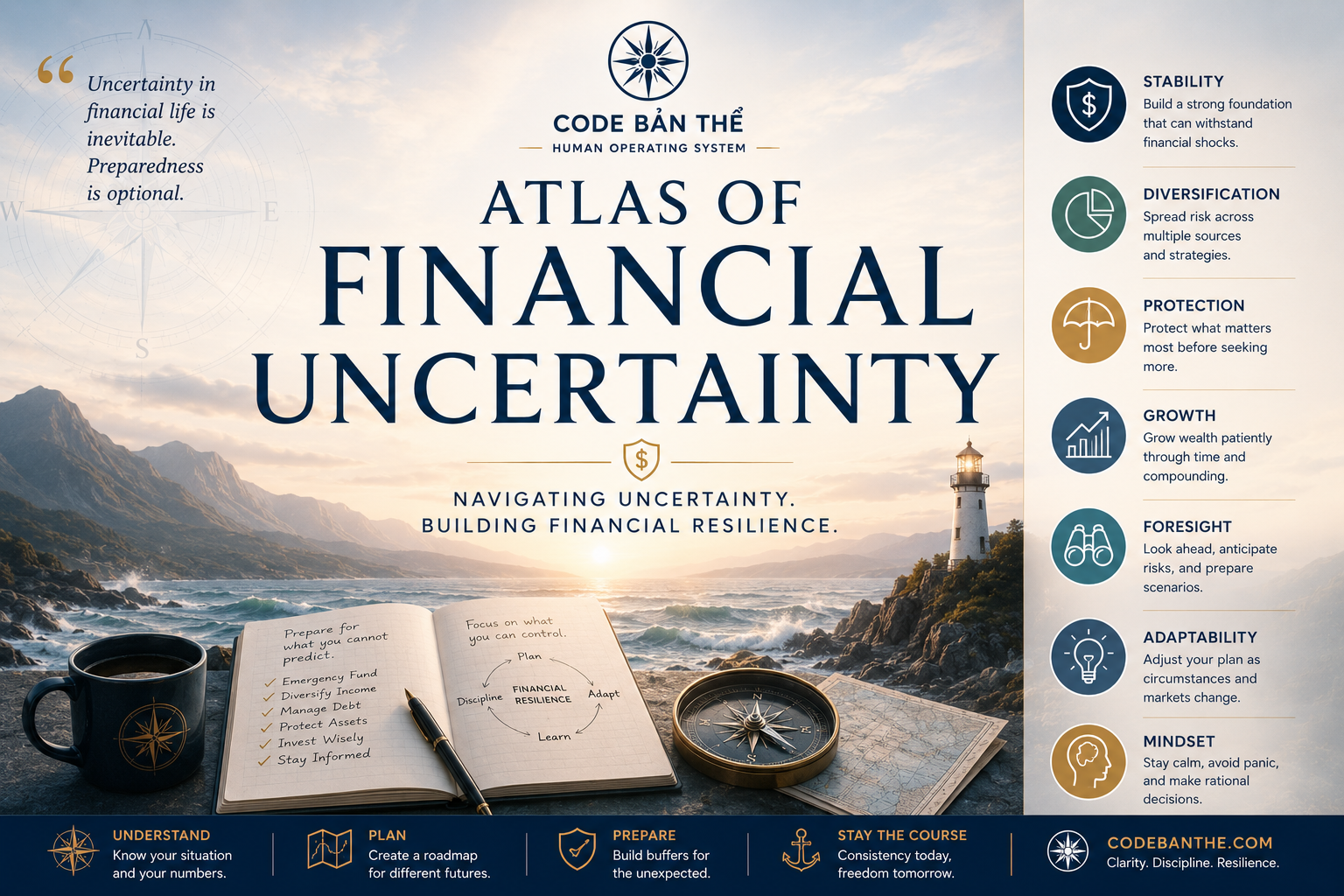
Atlas of Financial Uncertainty
Human Experience Atlas
A Map of Human Experience Under Financial Uncertainty
Most people think financial problems are about money.
But many of the most difficult experiences associated with money are not actually financial.
They are psychological.
Emotional.
Physiological.
A business owner cannot sleep because payroll is due next week.
A trader checks the market every few minutes.
A parent lies awake wondering how to pay future expenses.
An employee worries about layoffs even though nothing has happened yet.
A young professional delays important decisions because income feels unstable.
The common factor is not necessarily a lack of money.
It is uncertainty.
Human beings can often tolerate difficulty better than uncertainty.
When the future becomes unclear, the mind begins generating possibilities.
The nervous system begins preparing for threats.
Attention becomes consumed by scenarios that may never happen.
This Atlas is an attempt to map that territory.
What Is Atlas of Financial Uncertainty?
Atlas of Financial Uncertainty is part of the Human Experience Atlas.
Its purpose is not to teach investing.
It is not a guide to personal finance.
It is not a business strategy manual.
Its purpose is to help people recognize the human experience that emerges when financial outcomes become uncertain.
Many people believe they are experiencing:
stress
anxiety
loss of motivation
poor concentration
irritability
emotional exhaustion
In some cases, these experiences may be connected to an underlying condition:
The future no longer feels predictable.
Financial uncertainty is often experienced long before any actual financial collapse occurs.
The anticipation itself becomes part of the experience.
Common Experiences
Financial uncertainty can appear as:
checking account balances repeatedly
constantly calculating future expenses
difficulty sleeping
difficulty concentrating
delaying decisions
feeling trapped between options
imagining worst-case scenarios
becoming unusually cautious
feeling guilty when spending money
losing enjoyment in everyday activities
becoming emotionally unavailable
constantly seeking reassurance
Many people do not describe these experiences as financial.
Yet money may be the invisible force shaping them.
Recognizing The Pattern
Several patterns appear repeatedly across different situations.
The Future Becomes More Important Than The Present
The mind stops focusing on what is happening now.
Instead, it becomes occupied with what might happen later.
Attention shifts from reality to prediction.
Threat Detection Increases
Potential risks receive more attention than potential opportunities.
Small financial signals suddenly feel important.
Expenses appear larger.
Mistakes appear more dangerous.
The nervous system begins scanning for threats.
Decision Quality Changes
Financial uncertainty often changes how people make decisions.
Some become impulsive.
Some become frozen.
Some delay action indefinitely.
Others take risks they would never normally take.
The issue is not intelligence.
The issue is that uncertainty changes perception.
Recovery Becomes Difficult
Even during rest, the problem feels unresolved.
The person may be physically safe.
But the nervous system continues acting as if danger is approaching.
Regions Within The Atlas
Financial uncertainty appears in many forms.
Cash Flow Pressure
This region involves uncertainty around incoming and outgoing money.
Examples include:
delayed customer payments
payroll obligations
inventory financing
debt repayments
operating expenses
The experience is often less about total wealth and more about timing.
Market Uncertainty
This region appears when outcomes depend on markets.
Examples include:
commodity trading
stock investing
cryptocurrency
foreign exchange
business cycles
Prices move.
Information changes.
The future becomes difficult to predict.
Employment Uncertainty
This region appears when income stability feels threatened.
Examples include:
layoffs
contract work
career transitions
unstable demand
automation concerns
The uncertainty may exist even before any actual loss occurs.
Family Financial Pressure
This region appears when financial uncertainty affects people who depend on us.
Examples include:
supporting children
caring for aging parents
medical expenses
education costs
housing obligations
The pressure often increases because responsibility extends beyond the individual.
Opportunity Uncertainty
This region appears when a person must decide whether to invest, expand, change careers, start a business, or pursue a new opportunity.
The challenge is not knowing whether the future reward justifies the present risk.
Coordinates Within This Atlas
The following articles explore specific locations within the Atlas of Financial Uncertainty.
Cash Flow Pressure
When Cash Flow Becomes An Emotional Problem
The Hidden Cost Of Uncertainty
Why Business Owners Cannot Sleep During Financial Pressure
When Responsibility Lasts Longer Than Expected
Market Pressure
Human Behavior Under Financial Pressure
Why People Panic During Market Volatility
Why Intelligent Investors Still Make Bad Decisions
A Trader Checks The Chart 200 Times A Day
Liquidity & Survival
The First Experience Of Running Out Of Liquidity
When Revenue Has Not Arrived Yet
Living Between Hope And Exhaustion
The Experience Of Financial Survival Mode
Family Responsibility
Caring For Aging Parents While Managing Financial Pressure
When Family Obligations Exceed Financial Capacity
The Hidden Weight Of Providing For Others
Decision Making Under Uncertainty
Why Fear Looks Like Intuition
Why Pressure Changes Decision Quality
Why Intelligent People Lose Clarity
When Urgency Feels More Important Than Truth
What Financial Uncertainty Is Often Mistaken For
Many people assume the problem is:
weakness
poor discipline
lack of confidence
lack of motivation
emotional instability
Sometimes those explanations are incomplete.
A person may not lack motivation.
They may be carrying too much unresolved uncertainty.
A trader may not be addicted to charts.
The nervous system may simply be searching for certainty.
A business owner may not be obsessed with numbers.
The future of the company may feel unclear.
A parent may not be overly worried.
They may be trying to protect people who depend on them.
When uncertainty becomes visible, many behaviors begin to make more sense.
The Experience Of Living Without A Clear Future
One of the most difficult aspects of financial uncertainty is that it rarely announces itself dramatically.
It often arrives quietly.
A delayed payment.
A shrinking market.
A lost customer.
A medical expense.
An unexpected bill.
A period without income.
None of these events seem large on their own.
But together they begin altering perception.
The person starts calculating constantly.
Future possibilities occupy attention.
The nervous system remains partially activated.
Eventually, the experience is no longer about money alone.
It becomes a way of living.
A Question Larger Than Money
The deeper question may not be:
How much money do people need?
The deeper question may be:
How much uncertainty can a human nervous system carry before perception begins to change?
This question connects financial uncertainty to:
stress
burnout
leadership pressure
decision making
relationships
health
meaning
nervous system regulation
Money is often only the surface.
Uncertainty may be the deeper structure.
Human Experience Atlas
Every recognized experience is a coordinate.
Every concept is a navigation tool.
Every article is a location on the map of human experience.
This Atlas is not an attempt to provide a final explanation of financial uncertainty.
It is an attempt to see more clearly a region of human experience that affects business owners, traders, employees, parents, caregivers, and anyone whose future feels uncertain.
It belongs to the Human Experience Atlas:
A map of universal human experiences.
Guiding Principle
See more clearly.
Operate more effectively.
Build value that compounds over time.
Start with the problem you are experiencing today
🔍 Ask Code Bản Thể
Popular Life Situations / Các Tình Huống Phổ Biến
😴 Can't Sleep / Khó Ngủ • 😰 Stress & Anxiety / Căng Thẳng Lo Âu • 🔋 No Energy / Hết Năng Lượng • 😔 Feeling Empty / Buồn Trong Người • 🧠 Overthinking / Suy Nghĩ Quá Nhiều • 🔥 Burnout / Kiệt Sức💰 Money Problems / Đói Tiền • 💼 Hard To Find A Job / Kiếm Việc Khó Quá • 🚪 Want To Quit My Job / Muốn Nghỉ Việc • 👦 Child Can't Focus / Con Không Tập Trung • ❤️ Relationship Problems / Vấn Đề Tình Cảm • 👴 Caring For Aging Parents / Chăm Sóc Cha Mẹ Già
📚 Explore The Books / Khám Phá Bộ Sách
Human Experience Atlas
This article describes one coordinate within the Human Experience Atlas.
Explore the broader map to understand how different human experiences, pressures, and life situations connect to one another.
Explore the AtlasBank Debt, Mortgages, and Refinancing: Why the Hardest Part Is Sometimes What Happens Inside the Person, Not the Loan
Bank Debt, Mortgages, and Refinancing: Why the Hardest Part Is Sometimes What Happens Inside the Person, Not the Loan There […]
Read more →Bank Pressure in Real Estate
Bank Pressure in Real Estate There was a time when the monthly bank payment was simply another item on the […]
Read more →The Hidden Cost of Owning Property That No Longer Has Liquidity
The Hidden Cost of Owning Property That No Longer Has Liquidity On paper, the family was still wealthy. They owned […]
Read more →Recovery: Life After Financial Pressure and the Slow Rebuilding of Liquidity
Recovery: Life After Financial Pressure and the Slow Rebuilding of Liquidity For nearly two years, a business owner began every […]
Read more →How to Survive a Cash Flow Crisis
How to Survive a Cash Flow Crisis? The first sign is rarely an empty bank account. It is the way […]
Read more →The Hidden Cost of Illiquidity in Real Estate
A family owns a property worth billions of đồng. On paper, they are wealthy. The house is in a good […]
Read more →Cash Flow Is a Nervous System Problem Before It Becomes a Financial Problem
Cash Flow Is a Nervous System Problem Before It Becomes a Financial Problem He did not realize when the numbers […]
Read more →Cash Flow vs. Net Worth: Why a Wealthy Family Can Still Feel Financially Trapped
Cash Flow vs. Net Worth: Why a Wealthy Family Can Still Feel Financially Trapped A family may own a valuable […]
Read more →Family Paying the Bank Every Month
Family Paying the Bank Every Month Every month began the same way. Salary came in. Within a day, a large […]
Read more →Explore the Books
Continue the journey through Code Bản Thể books and the Human Operating System.
Explore The Books →Share Your Experience
What are you going through that is difficult to put into words?
It may be financial pressure, insomnia, caregiving, burnout, leadership stress, uncertainty, relationship challenges, or an experience that feels difficult to explain.
You do not need to write perfectly. Simply tell your story.
You may share:
- What is happening in your life right now?
- What has been on your mind the most lately?
- What feels most difficult, stressful, or exhausting?
- What have you tried so far?
- What surprised you?
- If you could give this experience a name, what would you call it?
Not every experience needs an immediate solution. Sometimes the first step is simply finding language for what you are experiencing.
Human Experience Atlas was created to help people see, recognize, and map the experiences they are living through.