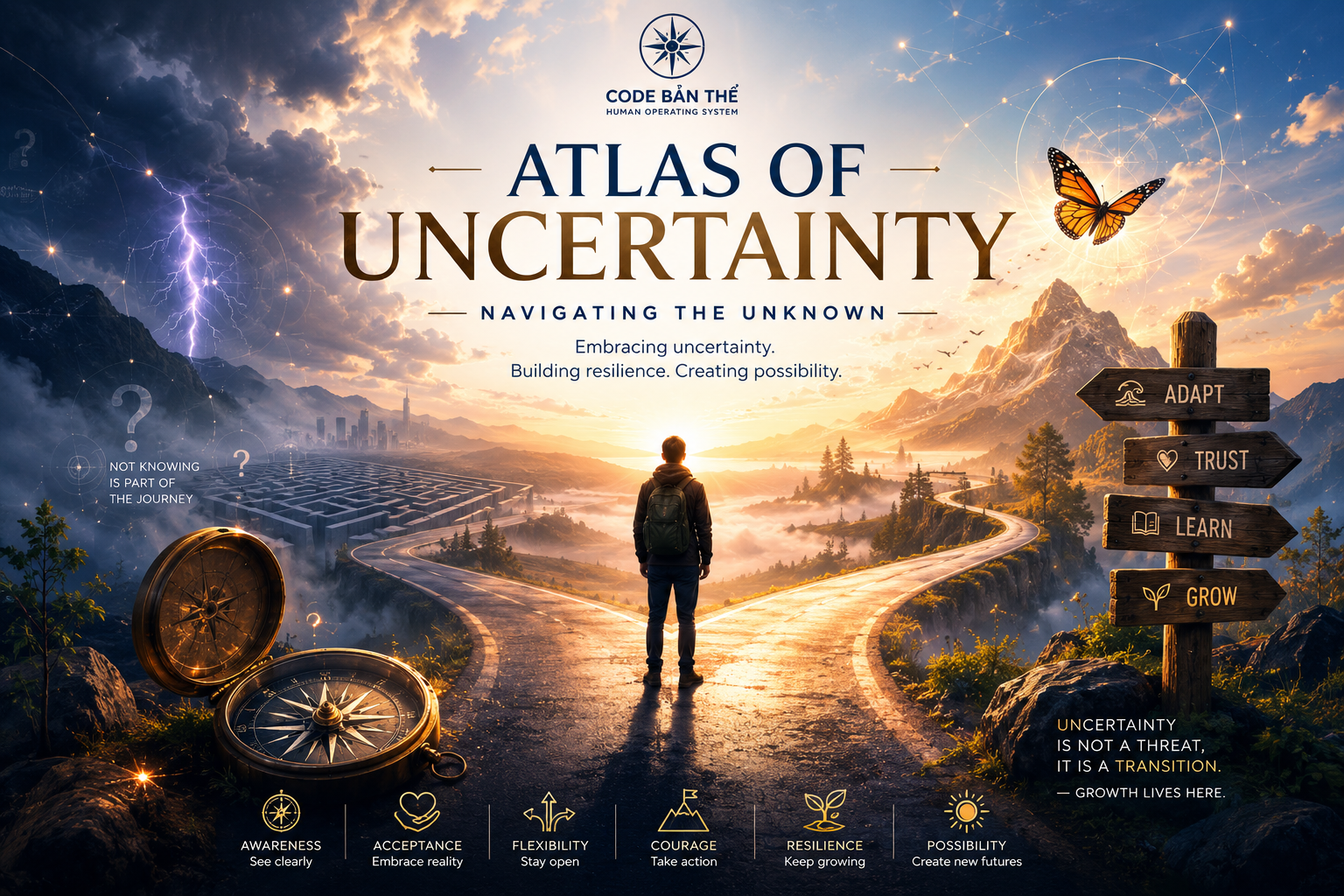
Atlas of Uncertainty
Uncertainty is one of the most universal human experiences. It emerges whenever the brain can no longer confidently predict what will happen next. Whether the uncertainty involves health, finances, relationships, work, or the future, the nervous system begins searching for patterns that can restore a sense of stability.
Within the Human Experience Atlas, uncertainty is understood not simply as a lack of information, but as a disruption of the brain’s predictive model. This often explains why people repeatedly check their phones, refresh financial charts, seek reassurance, or become attached to routines during stressful periods. These behaviors are frequently attempts to rebuild predictability rather than signs of irrationality.
The Atlas of Uncertainty explores how people perceive, respond to, and adapt when the future becomes unclear. It connects topics such as decision-making under pressure, anxiety, waiting, financial stress, health crises, leadership challenges, and nervous system regulation into one integrated map of human experience.
Rather than asking how uncertainty can be eliminated, this atlas asks a different question:
How can a Human Operating System remain clear, adaptive, and effective even when certainty is impossible?
Human Experience Atlas
This article describes one coordinate within the Human Experience Atlas.
Explore the broader map to understand how different human experiences, pressures, and life situations connect to one another.
Explore the AtlasLiving With Irreducible Uncertainty
Living With Irreducible Uncertainty A factory owner sat quietly in his office after reviewing the monthly numbers. Sales had stabilized. […]
Read more →He Left Banking to Escape Uncertainty – Then Found It Waiting at the Resort
He Left Banking to Escape Uncertainty—Then Found It Waiting at the Resort One of my good friends once believed that […]
Read more →Why Clarity Reduces Uncertainty
Why Clarity Reduces Uncertainty A business owner sat in front of his computer for nearly three hours. Not because he […]
Read more →Why Uncertainty Starts Small
Why Uncertainty Starts Small A homeowner received a message from the bank. Nothing alarming. Just a reminder that the interest […]
Read more →A Broker Doesn’t Sell Commodities. A Broker Sells Reduced Uncertainty.
A Broker Doesn’t Sell Commodities. A Broker Sells Reduced Uncertainty. Most people misunderstand what a broker actually sells. They think […]
Read more →Information Does Not Remove Uncertainty
Information Does Not Remove Uncertainty Every morning, before the markets open, a commodity trader follows the same routine. He checks […]
Read more →Knowing What to Do When You Don’t Yet Know What to Do
Knowing What to Do When You Don’t Yet Know What to Do Problem-Solving Under Uncertainty: Progress Before the Solution Exists […]
Read more →Knowing What to Do When You Don’t Yet Know What to Do
Knowing What to Do When You Don’t Yet Know What to DoProblem-Solving Under Uncertainty: Progress Before the Solution Exists A […]
Read more →Human Behavior Under Uncertainty
Human Behavior Under Uncertainty A business owner checks his phone before breakfast. No message. He checks again while drinking coffee. […]
Read more →Start with the problem you are experiencing today
🔍 Ask Code Bản Thể
Popular Life Situations / Các Tình Huống Phổ Biến
😴 Can't Sleep / Khó Ngủ • 😰 Stress & Anxiety / Căng Thẳng Lo Âu • 🔋 No Energy / Hết Năng Lượng • 😔 Feeling Empty / Buồn Trong Người • 🧠 Overthinking / Suy Nghĩ Quá Nhiều • 🔥 Burnout / Kiệt Sức💰 Money Problems / Đói Tiền • 💼 Hard To Find A Job / Kiếm Việc Khó Quá • 🚪 Want To Quit My Job / Muốn Nghỉ Việc • 👦 Child Can't Focus / Con Không Tập Trung • ❤️ Relationship Problems / Vấn Đề Tình Cảm • 👴 Caring For Aging Parents / Chăm Sóc Cha Mẹ Già
📚 Explore The Books / Khám Phá Bộ Sách
Explore the Books
Continue the journey through Code Bản Thể books and the Human Operating System.
Explore The Books →Share Your Experience
What are you going through that is difficult to put into words?
It may be financial pressure, insomnia, caregiving, burnout, leadership stress, uncertainty, relationship challenges, or an experience that feels difficult to explain.
You do not need to write perfectly. Simply tell your story.
You may share:
- What is happening in your life right now?
- What has been on your mind the most lately?
- What feels most difficult, stressful, or exhausting?
- What have you tried so far?
- What surprised you?
- If you could give this experience a name, what would you call it?
Not every experience needs an immediate solution. Sometimes the first step is simply finding language for what you are experiencing.
Human Experience Atlas was created to help people see, recognize, and map the experiences they are living through.