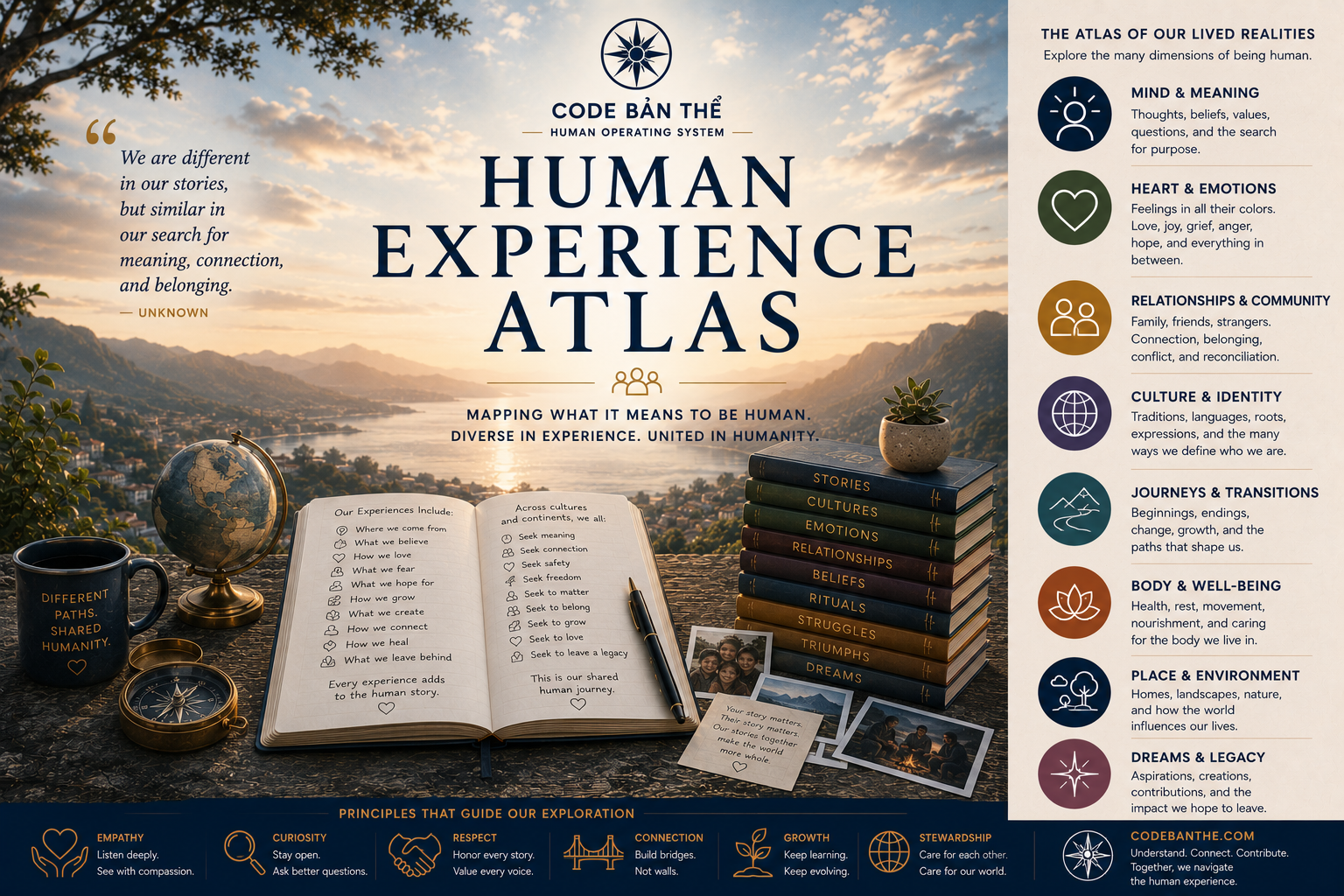
Human Experience Atlas
A map of the universal experiences people have always lived through, but have not always ahad the language to see.
Human Experience Atlas
created by
Hồ Quang Bình.
New Here?
Start with the video short introductions.
Learn why Human Experience Atlas exists and why many human experiences remain difficult to recognize, describe, or understand.
And A quick guide to understanding how this atlas works and how to navigaate the website.
Mới đến đây?
Hãy bắt đầu vơi video ngắn dưới đây.
Video giới thiệu lý do Human Experience Atlas được xây dựng và vì sao nhiều trải nghiệm quan trọng của con người vẫn chưa có đủ ngôn ngữ để nhận diện.
Video hướng dẫn nhanh cách sử dụng Human Experience Atlas và cách khám phá website này.
Human Experience Atlas is an ongoing effort to identify, describe, and map universal human experiences that have always existed but have not yet been fully recognized, named, or understood.
It is not a psychological theory.
It is not a philosophy.
It is not a self-help system.
It is a map.
A map of what people actually experience.
Human Experience Atlas Definition
Human Experience Atlas is a structured knowledge system that maps recurring human experiences into navigable cognitive architectures rather than encyclopedia articles
It organizes human experiences as interconnected knowledge structures, enabling people to explore relationships between cognition, emotion, behavior, perception, decision-making, and the nervous system.
Why Human Experience Atlas Exists
Many people spend years living through experiences they cannot clearly describe.
They know something is happening.
They feel it.
They live inside it.
But they lack the language to recognize it.
Examples include:
Sleeping but not feeling restored.
Feeling constantly alert even when no immediate danger exists.
Working harder while becoming less clear.
Achieving success while feeling increasingly empty.
Wanting to rest but being unable to relax.
Feeling that something is wrong without knowing what it is.
These experiences are often dismissed, misunderstood, or grouped into broad categories such as:
Stress
Anxiety
Burnout
Motivation
Fatigue
Yet many people intuitively feel that these labels do not fully explain what they are experiencing.
Human Experience Atlas begins from that observation.
How To Use This Atlas
Step 1: Start With Your Situation
Step 2: Identify The Pattern
Step 3: Locate Your Coordinate
Step 4: Explore Connected Experiences
Step 5: Move From Recognition To Understanding
A Different Way To Read
Start Exploring
By Life Situation
Business & Leadership
Money & Uncertainty
Parenting & Family
Learning & Performance
Relationships
Inner Peace
Meaning & Purpose
By Experience
Stress
Burnout
Pressure
Exhaustion
Uncertainty
Decision Making
Nervous System States
By Atlas Region
Atlas of Stress
Atlas of Burnout
Atlas of Leadership Pressure
Atlas of Financial Uncertainty
Atlas of Parenting
Atlas of Decision Fatigue
Atlas of Inner Peace
Atlas of Human Development
Atlas of Nervous System States
Atlas of Meaning
The Core Assumption
Human beings often experience something long before they have language for it.
History offers many examples.
People experienced stress before the word “stress” existed.
People experienced burnout before the term “burnout” was created.
Artists, athletes, and performers entered flow states long before anyone described the phenomenon scientifically.
The experience existed first.
The language came later.
Human Experience Atlas asks a simple question:
How many human experiences already exist but remain unnamed, poorly described, or insufficiently mapped?
What Human Experience Atlas Studies
Human Experience Atlas focuses on experiences rather than theories.
Instead of asking:
What is the correct explanation?
It begins by asking:
What are people actually experiencing?
Examples include:
The business owner who cannot sleep because of inventory pressure.
The parent who feels guilty despite doing their best.
The trader who checks the chart two hundred times a day.
The student who studies constantly but cannot retain information.
The caregiver who feels exhausted but cannot stop.
The successful professional who no longer feels alive.
Each experience becomes a coordinate on the map.
Human Experience Atlas vs Psychology
Psychology often focuses on:
Causes
Mechanisms
Diagnosis
Treatment
Human Experience Atlas focuses on:
Recognition
Description
Patterns
Mapping
Psychology may ask:
What causes burnout?
Human Experience Atlas may ask:
What does burnout feel like before a person realizes they are burning out?
The two approaches are complementary rather than competitive.
One investigates mechanisms.
The other maps experiences.
Human Experience Atlas and Carl Jung
Human Experience Atlas is deeply aligned with the spirit of exploration found in the work of Carl Jung.
Jung helped humanity recognize experiences and structures that had long existed but were difficult to see clearly:
Shadow
Archetypes
Collective Unconscious
Human Experience Atlas continues the same exploration from a different direction.
The question is not:
What theories can be created?
The question is:
What experiences are people already living that still lack adequate language?
Human Experience Atlas vs Human Operating System
The two projects serve different functions.
Human Experience Atlas
Answers:
Where am I?
It provides coordinates.
It helps people recognize their current experience.
Human Operating System
Answers:
What is operating underneath this experience?
It provides mechanisms.
It helps people understand how attention, perception, emotion, decision-making, and the nervous system interact.
Atlas is the map.
Human Operating System is the operating manual.
Together, they help people see more clearly and operate more effectively.
The Structure of Human Experience Atlas
Level 1: Continents
Major regions of human experience.
Examples:
Atlas of Stress
Atlas of Burnout
Atlas of Leadership Pressure
Atlas of Financial Uncertainty
Atlas of Parenting
Atlas of Decision Making
Atlas of Inner Peace
Atlas of Human Development
Atlas of Nervous System States
Atlas of Meaning
Level 2: Regions
Specific categories within each continent.
Examples:
Inventory Pressure
Cash Flow Pressure
Decision Fatigue
Caregiver Exhaustion
Performance Anxiety
Level 3: Coordinates
Individual human experiences.
Examples:
The Business Owner Who Cannot Sleep Because of Inventory
The Parent Who Misunderstood a Child’s Tears
The Student Who Studies Hard but Feels Stuck
The Trader Who Keeps Refreshing the Screen
The Executive Who Looks Calm but Feels Exhausted
Each article represents a coordinate within the Atlas.
The Long-Term Vision
The goal of Human Experience Atlas is not to create as many concepts as possible.
The goal is not to produce endless theories.
The goal is to help people recognize what they are already living.
Success is measured by a simple moment:
When someone reads a description and says:
That is exactly what I have been experiencing.
And for the first time, they have language for it.
Human Experience Atlas
Every recognized experience is a coordinate.
Every concept is a navigation tool.
Every article is a location on the map of human experience.
This project is not an attempt to create answers for everything.
It is an attempt to see more clearly a region of human life that has always existed but has not yet been fully described.
Human Experience Atlas is a map of universal human experiences.
A map designed to help people recognize themselves, understand their experience, and navigate life with greater clarity
See more clearly.
Operate more effectively.
Build value that compounds over time.
Human Experience Atlas
is part of
Code Bản Thể.
Start with the problem you are experiencing today
🔍 Ask Code Bản Thể
Popular Life Situations / Các Tình Huống Phổ Biến
😴 Can't Sleep / Khó Ngủ • 😰 Stress & Anxiety / Căng Thẳng Lo Âu • 🔋 No Energy / Hết Năng Lượng • 😔 Feeling Empty / Buồn Trong Người • 🧠 Overthinking / Suy Nghĩ Quá Nhiều • 🔥 Burnout / Kiệt Sức💰 Money Problems / Đói Tiền • 💼 Hard To Find A Job / Kiếm Việc Khó Quá • 🚪 Want To Quit My Job / Muốn Nghỉ Việc • 👦 Child Can't Focus / Con Không Tập Trung • ❤️ Relationship Problems / Vấn Đề Tình Cảm • 👴 Caring For Aging Parents / Chăm Sóc Cha Mẹ Già
📚 Explore The Books / Khám Phá Bộ Sách
Latest Human Experience Atlas Articles
- Panic Disorder Is Not Just a Diagnosis. It Is a Human Experience.
- What Does Burnout Feel Like Before a Person Realizes They Are Burning Out
- How Is the Human Experience Atlas Different from Wikipedia
- One Living System-How Everything I Am Building Connects
- When Experience Leads to the Same Principles
- Activation Precedes Value
- Networks Become Intelligent When Activation Continuously Expands the Network Itself
- Transitions Create Understanding
- Value Cannot Emerge Until Something Becomes Meaningfully Activated
- How Should a System Be Designed So That Every Meaningful Interaction Naturally Increases the Future Value of the Entire System?
- Future Activation
- When There Is No One Left Who Remembers Your Life
- Who Gives a Person the Right to Be Good Again
- The Smallest Indivisible Unit of Activation Architecture
- How a Decision-Making System Works Beneath Conscious Thought
- Human Behavior Under Uncertainty
- The Parent Who Hasn’t Slept Through the Night in Weeks
- When the Explanation Sounds Reasonable but the Money Never Arrives
- Who Trains the Nervous System?
- Learning Is Not Only About Knowledge. It Is Nervous System Training.
Explore the Books
Continue the journey through Code Bản Thể books and the Human Operating System.
Explore The Books →Share Your Experience
What are you going through that is difficult to put into words?
It may be financial pressure, insomnia, caregiving, burnout, leadership stress, uncertainty, relationship challenges, or an experience that feels difficult to explain.
You do not need to write perfectly. Simply tell your story.
You may share:
- What is happening in your life right now?
- What has been on your mind the most lately?
- What feels most difficult, stressful, or exhausting?
- What have you tried so far?
- What surprised you?
- If you could give this experience a name, what would you call it?
Not every experience needs an immediate solution. Sometimes the first step is simply finding language for what you are experiencing.
Human Experience Atlas was created to help people see, recognize, and map the experiences they are living through.