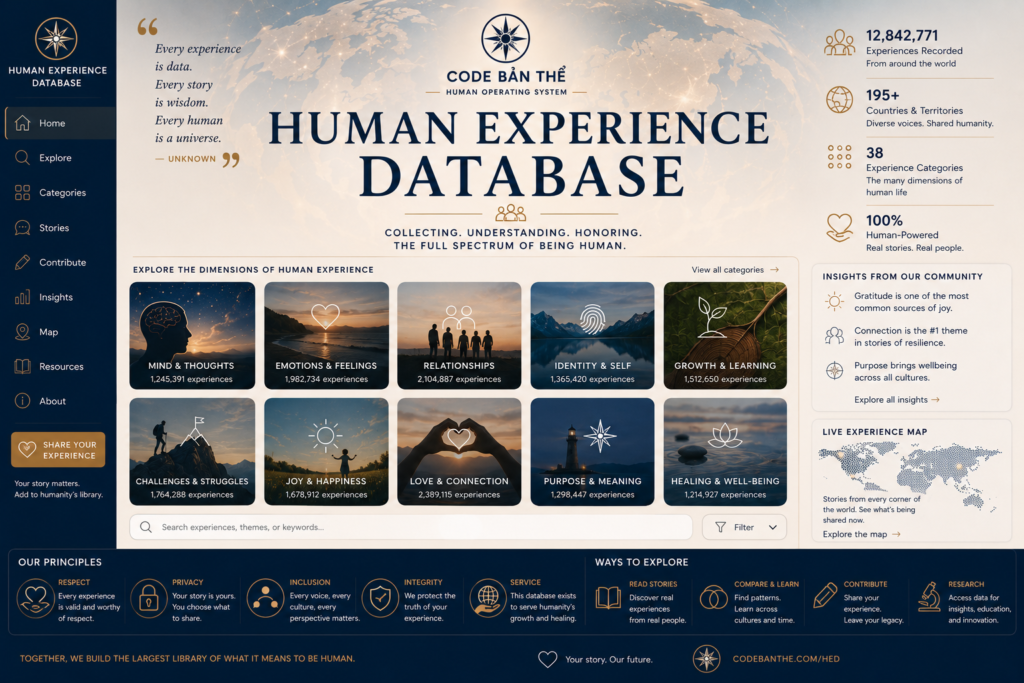
Human Experience Database
A Living Knowledge System for Mapping Human Experience
Human Experience Database is the structured knowledge layer of the Human Experience Atlas.
Rather than storing isolated articles, it organizes human experiences into an interconnected network of life situations, experiential patterns, Atlas regions, educational lessons, books, and underlying operating mechanisms.
Each new article expands not only the collection itself, but also the relationships between experiences, allowing readers to navigate human life as a connected system rather than a series of disconnected stories.
Most websites publish articles.
This project connects experiences.
Every article inside the Human Experience Atlas is designed to become one coordinate within a much larger knowledge system.
Rather than existing as isolated pages, each article becomes part of an interconnected network that helps readers understand not only one experience but its relationship to many others.
The Human Experience Database is the structural layer that makes this possible.
Why Human Experience Database Exists
Human life is rarely experienced as separate topics.
A parent may also be a caregiver.
A business owner may also struggle with burnout.
Financial uncertainty may become relationship conflict.
Leadership pressure may become loneliness.
One experience often leads to another.
Traditional websites organize knowledge into separate articles.
Human Experience Database organizes knowledge into connected human experiences.
Its purpose is not simply to store information.
Its purpose is to reveal structure.
From Articles to Knowledge
An article answers one question.
A database reveals many relationships.
For example:
A reader searching for:
Why do I feel exhausted?
may discover:
↓
↓
↓
↓
↓
The Modern Human Operating Crisis
The answer becomes larger than the original question.
This is the purpose of Human Experience Database.
The Human Experience Graph
Every experience belongs to a larger network.
Example:
↓
↓
↓
↓
↓
The Modern Human Operating Crisis
The experience is no longer isolated.
It becomes understandable through its connections.
Four Layers of Connection
Every article inside the database may connect through four structural pathways.
Related Atlas
Every experience belongs somewhere within the larger Human Experience Atlas.
Examples include:
Atlas of Financial Uncertainty
These Atlases organize recurring territories of human experience.
Related Life Situations
Experiences rarely happen in isolation.
Each article connects to similar real-world situations.
Examples include:
Waiting for Medical Test Results
Losing Motivation After Promotion
The Trader Who Checks Prices Every Five Minutes
Living With Invisible Responsibility
Readers often arrive through one situation and discover many others they never knew were connected.
Related Lessons
Knowledge becomes more valuable when it transfers across different stages of life.
A lesson for children may explain an adult crisis.
A parenting article may illuminate leadership.
A business story may reveal the same operating pattern found in education.
Examples include:
Mistakes Are Information
Your Worth Is Bigger Than One Success
Trust Must Be Built
Think Before You Choose
The Brain Learns Through Practice
Lessons become bridges between experiences.
Related Books
Some experiences require deeper exploration than a single article can provide.
The database therefore connects each experience to longer conceptual works.
Examples include:
The Modern Human Operating Crisis
Books provide broader frameworks that help readers understand recurring patterns across many different experiences.
Experience Record
Every article contributes a structured record to the database.
Typical fields include:
Life Situation
Trigger
Root Experience
Experience Description
Behavior Patterns
Underlying Mechanisms
Human Needs
Hidden Costs
Related Atlas
Related Life Situations
Related Lessons
Related Books
Experience Classification
This allows knowledge to become searchable, comparable, and expandable over time.
Beyond Categories and Tags
Categories organize content.
Tags describe content.
Human Experience Database connects content.
Categories answer:
What type of article is this?
Tags answer:
What topics appear inside this article?
The database answers:
What other experiences are connected to this one?
This distinction transforms a collection of articles into a living knowledge system.
Human Experience Atlas as a Knowledge Network
Human Experience Atlas is not a collection of disconnected maps.
Each Atlas strengthens every other Atlas.
Stress connects with Parenting.
Parenting connects with Identity.
Identity connects with Meaning.
Waiting connects with Uncertainty.
The database makes these relationships visible.
Why This Matters
Many people know something feels wrong.
Few people know where that experience belongs.
Without orientation, people search randomly.
With orientation, people begin to recognize patterns.
Recognition creates clarity.
Clarity improves decisions.
Better decisions gradually transform lives.
The first step is often not finding an answer.
It is discovering where you are.
A Living Database
Human Experience Database is not intended to become a finished encyclopedia.
It is designed to remain a living system.
Every new article adds another experience.
Every new Atlas expands the map.
Every new connection strengthens the network.
Over time, the database grows not only in size, but also in intelligence.
Its value compounds through relationships rather than isolated information.
Long-Term Vision
The long-term goal is not simply to publish thousands of articles.
The goal is to build one of the world’s most comprehensive maps of recurring human experience.
Thousands of life situations.
Hundreds of Atlas regions.
Millions of possible connections.
One growing knowledge system dedicated to helping people understand themselves, others, and the invisible patterns shaping human life.
The Human Experience Database is the structural foundation that allows this vision to grow.
It is where individual experiences become connected knowledge.
Latest Human Experience Records
- Panic Disorder Is Not Just a Diagnosis. It Is a Human Experience.
- What Does Burnout Feel Like Before a Person Realizes They Are Burning Out
- How Is the Human Experience Atlas Different from Wikipedia
- One Living System-How Everything I Am Building Connects
- When Experience Leads to the Same Principles
- Activation Precedes Value
- Networks Become Intelligent When Activation Continuously Expands the Network Itself
- Transitions Create Understanding
- Value Cannot Emerge Until Something Becomes Meaningfully Activated
- How Should a System Be Designed So That Every Meaningful Interaction Naturally Increases the Future Value of the Entire System?
Latest Life Situations
- Finland — When Education Became an Activation Path
- Israel — When Building an Innovation Ecosystem Became an Activation Path
- Rwanda After the Genocide — When Reconciliation Became an Activation Path
- Germany After World War II — When Reconstruction Became an Activation Path
- South Africa — When Reconciliation Became an Activation Path
- India — When Nonviolence Became an Activation Path
- The United States After the American Revolution — When Institutions Became the Activation Path
- China After 1978 — When Reform and Opening Up Became the Activation Path
- South Korea After the Korean War — When Industrialization and Education Became the Activation Path
- Japan After World War II — When Quality Became the Activation Path
Latest Atlas Lessons
- The First Asset Is Not Your Assets
- The Question That Keeps Many Parents Awake When Their Children Grow Up
- The Question That Keeps Many Parents Awake
- The Greatest Investment I Can Make Is Not Teaching My Son AI.It’s Teaching Him How to Think
- Who Trains the Nervous System?
- Learning Is Not Only About Knowledge. It Is Nervous System Training.
- Education May Not Be Training the Brain. It May Be Training the Nervous System.
- Build a System Before You Build Wealth
- Does Not Need to Be Rich at 16
- My Son, Build Assets Before You Chase Income
Share Your Experience
What are you going through that is difficult to put into words?
It may be financial pressure, insomnia, caregiving, burnout, leadership stress, uncertainty, relationship challenges, or an experience that feels difficult to explain.
You do not need to write perfectly. Simply tell your story.
You may share:
- What is happening in your life right now?
- What has been on your mind the most lately?
- What feels most difficult, stressful, or exhausting?
- What have you tried so far?
- What surprised you?
- If you could give this experience a name, what would you call it?
Not every experience needs an immediate solution. Sometimes the first step is simply finding language for what you are experiencing.
Human Experience Atlas was created to help people see, recognize, and map the experiences they are living through.