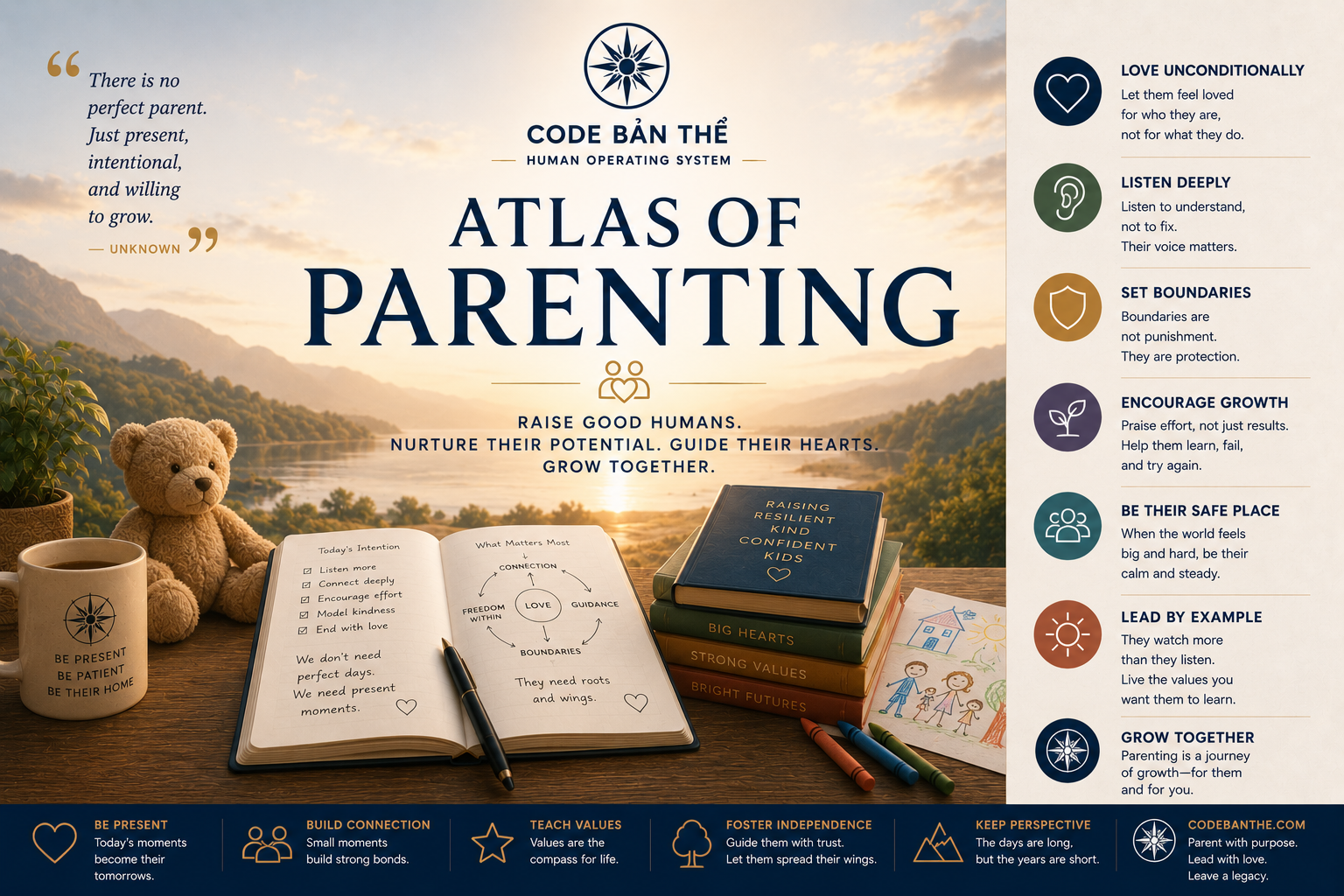
Atlas of Parenting
A Map of Parenting Experiences
Parenting is not a collection of techniques.
It is a collection of lived experiences.
Worry.
Responsibility.
Pride.
Exhaustion.
Hope.
Confusion.
Love.
The Atlas of Parenting maps the experiences parents repeatedly encounter while raising children.
What This Atlas Maps
What This Atlas Explores
This atlas documents recurring parenting experiences including:
• Child refuses to listen
• Child cannot focus
• Academic pressure
• Parent guilt
• Sibling conflict
• Teenage resistance
• Fear about the future
• Emotional distance
• Caring for aging parents while raising children
• Balancing work and family
These are not isolated events.
They are recurring human experiences.
Common Parenting Regions
Explore Parenting Regions
👶 Early Childhood
School Readiness
Attention Problems
Emotional Regulation
Learning Habits
🧒 School Years
Academic Pressure
Motivation Problems
Parent-Child Conflict
Digital Distraction
👦 Teen Years
Identity Formation
Independence
Communication Breakdown
Future Anxiety
👨👩👧 Family System
Sibling Relationships
Parental Expectations
Caregiver Stress
Multi-Generation Families
Human Experience Atlas Navigation
Part of the Human Experience Atlas
Parenting does not exist in isolation.
Many parenting experiences connect with:
→ Atlas of Stress
→ Atlas of Caregiving
→ Atlas of Leadership Pressure
→ Atlas of Financial Uncertainty
→ Human Experience Atlas
Understanding these connections helps reveal the larger map of human experience.
Start with the problem you are experiencing today
🔍 Ask Code Bản Thể
Popular Life Situations / Các Tình Huống Phổ Biến
😴 Can't Sleep / Khó Ngủ • 😰 Stress & Anxiety / Căng Thẳng Lo Âu • 🔋 No Energy / Hết Năng Lượng • 😔 Feeling Empty / Buồn Trong Người • 🧠 Overthinking / Suy Nghĩ Quá Nhiều • 🔥 Burnout / Kiệt Sức💰 Money Problems / Đói Tiền • 💼 Hard To Find A Job / Kiếm Việc Khó Quá • 🚪 Want To Quit My Job / Muốn Nghỉ Việc • 👦 Child Can't Focus / Con Không Tập Trung • ❤️ Relationship Problems / Vấn Đề Tình Cảm • 👴 Caring For Aging Parents / Chăm Sóc Cha Mẹ Già
📚 Explore The Books / Khám Phá Bộ Sách
Human Experience Atlas
This article describes one coordinate within the Human Experience Atlas.
Explore the broader map to understand how different human experiences, pressures, and life situations connect to one another.
Explore the AtlasThe Question That Keeps Many Parents Awake When Their Children Grow Up
The Question That Keeps Many Parents Awake When Their Children Grow Up When children are young, parents lose sleep over […]
Read more →The Question That Keeps Many Parents Awake
The Question That Keeps Many Parents Awake Will my child be able to operate their own life when I’m no […]
Read more →When Your Child Starts Protecting the Family’s Survival Point
When Your Child Starts Protecting the Family’s Survival Point For several weeks, my oldest son and I were building Cashew […]
Read more →Why Teaching Belief to Children Matters More Than We Think
Why Teaching Belief to Children Matters More Than We Think A child falls while learning to walk. One adult smiles […]
Read more →When Parents Wait for a Phone Call That Never Comes
When Parents Wait for a Phone Call That Never Comes Every evening, after dinner, an elderly couple sits quietly in […]
Read more →When a Child Becomes Too Good
When a Child Becomes Too Good This morning, I met a close friend. He manages the construction of large high-rise […]
Read more →The Father Who Worked Too Many Jobs
The Father Who Worked Too Many Jobs There is a kind of father who almost never appears tired in public. […]
Read more →Retired Parents Waiting for Their Children to Buy
Retired Parents Waiting for Their Children to Buy Retirement had changed the rhythm of their days. The alarm clock no […]
Read more →Waiting for Medical Test Results
Waiting for Medical Test Results There are moments when life becomes divided into two parts: Before the result. And after […]
Read more →Explore the Books
Continue the journey through Code Bản Thể books and the Human Operating System.
Explore The Books →Share Your Experience
What are you going through that is difficult to put into words?
It may be financial pressure, insomnia, caregiving, burnout, leadership stress, uncertainty, relationship challenges, or an experience that feels difficult to explain.
You do not need to write perfectly. Simply tell your story.
You may share:
- What is happening in your life right now?
- What has been on your mind the most lately?
- What feels most difficult, stressful, or exhausting?
- What have you tried so far?
- What surprised you?
- If you could give this experience a name, what would you call it?
Not every experience needs an immediate solution. Sometimes the first step is simply finding language for what you are experiencing.
Human Experience Atlas was created to help people see, recognize, and map the experiences they are living through.