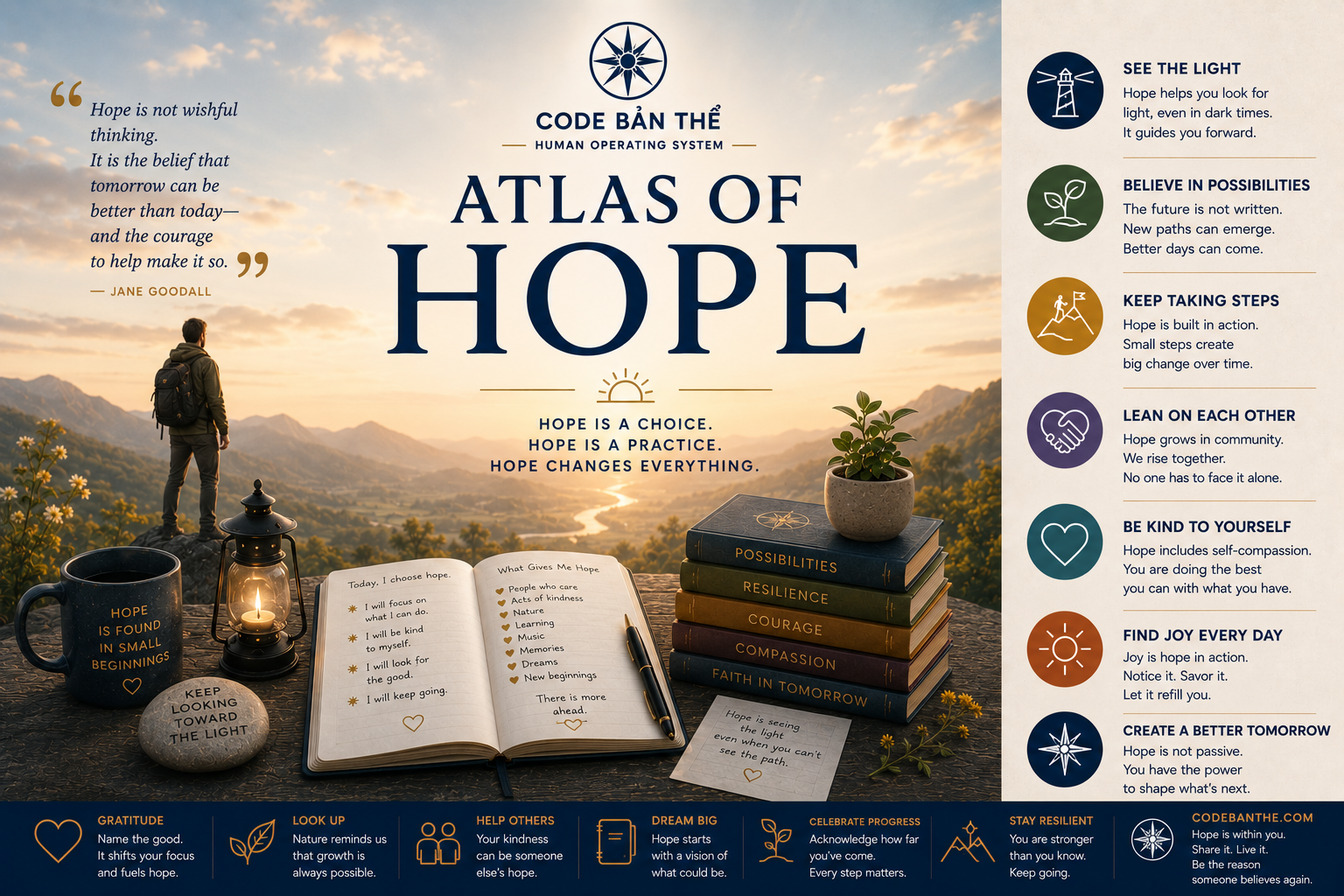
Atlas of Hope
Hope is often described as an emotion.
Activation Architecture treats it differently.
Hope is a structural property of a system that allows a person to perceive meaningful future pathways.
When people lose hope, they do not simply lose positive feelings.
They lose the ability to see where meaningful activation can continue.
This is why two people facing the same circumstances may respond in completely different ways.
One perceives only dead ends.
The other recognizes possible transitions.
The difference is not always external resources.
It is often the architecture of perceived possibility.
The Atlas of Hope maps the conditions under which hope emerges, weakens, disappears, and returns.
Rather than asking How can we feel more hopeful?, it asks a more fundamental question:
What structures enable people to recognize meaningful future pathways again?
This perspective applies across many domains:
personal recovery after failure,
long-term learning,
leadership during uncertainty,
organizations navigating disruption,
AI systems that guide exploration,
and societies facing complex change.
Within Activation Architecture, hope is not the destination.
It is an activation state that increases the probability of meaningful future activation.
Human Experience Atlas
This article describes one coordinate within the Human Experience Atlas.
Explore the broader map to understand how different human experiences, pressures, and life situations connect to one another.
Explore the AtlasHope Sometimes Arrives as a Smaller Next Step
Hope Sometimes Arrives as a Smaller Next Step There was a period in my life when hope became very simple. […]
Read more →When Someone Feels Understood Before They Receive Any Advice
When Someone Feels Understood Before They Receive Any Advice Yesterday, I met someone I had not seen for twenty years. […]
Read more →Financial Recovery Starts Before Money Returns
Financial Recovery Starts Before Money Returns There is a moment many business owners know well. Sales have been weak for […]
Read more →When Hope Replaces Strategy
When Hope Replaces Strategy He had stopped checking the market. Not because he had lost interest. Because every update looked […]
Read more →Why Do So Many People Sink Deeper the Harder They Try to Save Themselves
Why Do So Many People Sink Deeper the Harder They Try to Save Themselves? When people fall into financial trouble, […]
Read more →Recovery Is Not Only Financial. It is also neurological and psychological.
Recovery Is Not Only Financial. It is also neurological and psychological. For nearly two years, his life had been organized […]
Read more →Recovery: Life After Financial Pressure and the Slow Rebuilding of Liquidity
Recovery: Life After Financial Pressure and the Slow Rebuilding of Liquidity For nearly two years, a business owner began every […]
Read more →How to Survive a Cash Flow Crisis
How to Survive a Cash Flow Crisis? The first sign is rarely an empty bank account. It is the way […]
Read more →Bank Pressure in Real Estate
Bank Pressure in Real Estate There was a time when the monthly bank payment was simply another item on the […]
Read more →Start with the problem you are experiencing today
🔍 Ask Code Bản Thể
Popular Life Situations / Các Tình Huống Phổ Biến
😴 Can't Sleep / Khó Ngủ • 😰 Stress & Anxiety / Căng Thẳng Lo Âu • 🔋 No Energy / Hết Năng Lượng • 😔 Feeling Empty / Buồn Trong Người • 🧠 Overthinking / Suy Nghĩ Quá Nhiều • 🔥 Burnout / Kiệt Sức💰 Money Problems / Đói Tiền • 💼 Hard To Find A Job / Kiếm Việc Khó Quá • 🚪 Want To Quit My Job / Muốn Nghỉ Việc • 👦 Child Can't Focus / Con Không Tập Trung • ❤️ Relationship Problems / Vấn Đề Tình Cảm • 👴 Caring For Aging Parents / Chăm Sóc Cha Mẹ Già
📚 Explore The Books / Khám Phá Bộ Sách
Explore the Books
Continue the journey through Code Bản Thể books and the Human Operating System.
Explore The Books →Share Your Experience
What are you going through that is difficult to put into words?
It may be financial pressure, insomnia, caregiving, burnout, leadership stress, uncertainty, relationship challenges, or an experience that feels difficult to explain.
You do not need to write perfectly. Simply tell your story.
You may share:
- What is happening in your life right now?
- What has been on your mind the most lately?
- What feels most difficult, stressful, or exhausting?
- What have you tried so far?
- What surprised you?
- If you could give this experience a name, what would you call it?
Not every experience needs an immediate solution. Sometimes the first step is simply finding language for what you are experiencing.
Human Experience Atlas was created to help people see, recognize, and map the experiences they are living through.